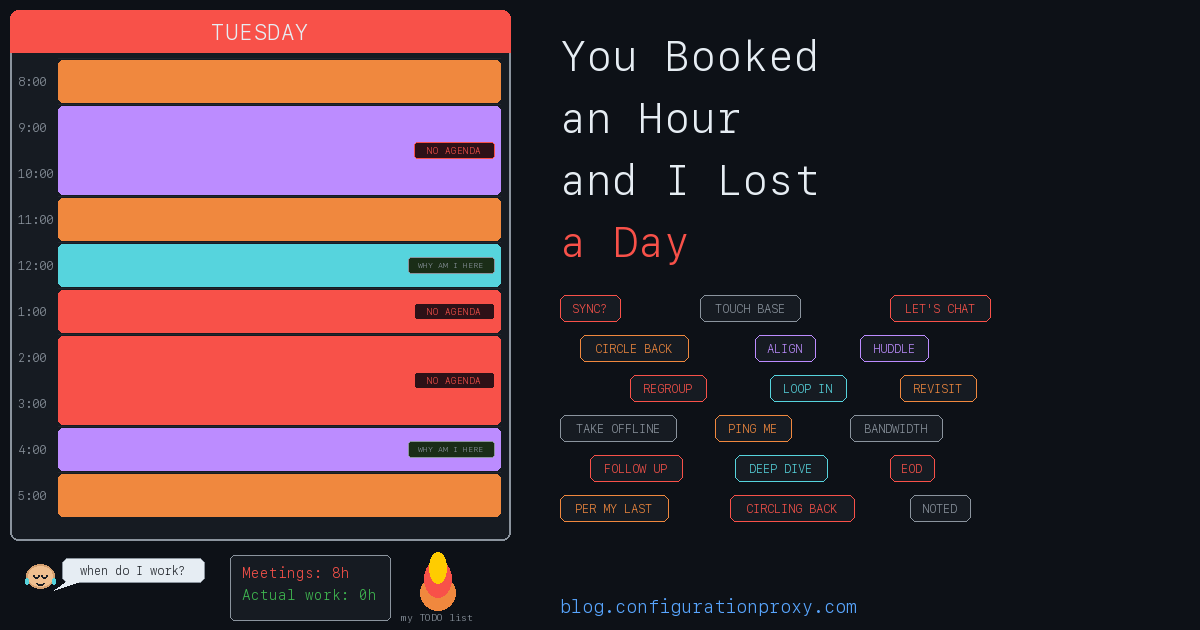
I have fires to put out. Actual problems that need solving. Things that are broken, things that are about to break, things that someone broke three weeks ago and nobody noticed until today. On top of that I have projects to deliver, features to build, things that are supposed to add value to the business. My calendar should reflect that. Instead it looks like a game of Tetris where every block is red and none of them clear.
Scope creep has a cousin. It’s called meeting creep and nobody talks about it because somehow meetings became sacred. You can push back on a feature request. You can say no to a scope change. But declining a meeting? That’s “not being a team player.” And sometimes the meeting exists because someone made a bad assumption, didn’t understand the full context, or asked Claude and took the answer at face value without checking if it was actually correct. Now there’s a meeting to clean up a decision that was wrong from the start because nobody asked “are you sure?” or “why?” or any of the questions that would have forced someone to actually understand the problem before acting on it.
Improv With a Conference Line
Too many meetings. Not enough good ones.
No agenda. No pre-read. No goal. Just a calendar invite with a vague title and a room full of people figuring out what they’re doing there in real time. Jeff Bezos has a rule at Amazon: every meeting starts with a written memo that everyone reads silently before anyone speaks. The memo forces the organizer to actually think through what they want to discuss. Most companies skip that part entirely. They show up and improvise. That’s not a meeting. That’s improv with a conference line.
Meetings that end with no actionable items. You sit there for 30 to 60 minutes, people talk, ideas bounce around, heads nod, and then it’s over. No owners. No deadlines. No decisions. What was the point? If nobody left with something to do, that meeting produced nothing. And the worst part is you’ll probably have the same meeting next week because nothing got resolved.
People in the room who don’t need to be there. Ten people on a call when three of them needed to be involved. The other seven are watching a conversation they have no stake in. That’s not collaboration. That’s an audience. And if you’re one of the seven, you just lost an hour you could have spent on actual work. Do that enough times and your 8 hour day becomes a 12 hour day because the actual work still needs to get done. It just gets pushed to early mornings and late nights.
And then the opposite. People missing who should be there. The one person who has the answer or needs to make the decision isn’t in the room. So you have the meeting, talk in circles, can’t resolve anything, and schedule another meeting with the right person this time. Two meetings for the price of one, except both of them cost everyone’s time.
It’s Not the Hour, It’s the Day
My time is valuable. Not in some abstract “time is money” way. In a very real “I have 47 things in my queue and three of them are on fire” way. The more meetings you’re in, the more responsibilities you usually have. Those responsibilities don’t pause because you’re sitting in a room listening to someone read their slides out loud. And honestly, at least slides mean someone cared enough to plan. That’s more than most meetings get.
Every meeting is a context switch. You’re deep in a problem, you’ve got the whole thing loaded in your head, you’re about to figure it out. Meeting time. You stop, you sit, you listen to something unrelated for an hour, and then you come back to your desk and spend 20 minutes remembering where you were. Multiply that by three or four meetings in a day and you’ve lost the entire day. Not to the meetings themselves, but to the gaps between them where you can’t get anything meaningful done.
That’s the real cost. It’s not the hour on the calendar. It’s the hours around it that become useless.
So Fix It
Every meeting should have a specific goal and a specific expected outcome. Before you send that invite, answer two questions: what are we deciding, and what should everyone walk away with? If you can’t answer both, don’t book the meeting. Send a message instead.
Have an agenda. Write it down. Send it ahead of time. If people can read it before the meeting and show up prepared, you cut the meeting time in half because you’re not spending the first 20 minutes getting everyone up to speed. This is the Bezos memo thing and it works. The prep is the point. If the organizer can’t be bothered to prepare, why should the attendees?
Meetings need multiple voices. If one person talks the entire time, that’s a presentation, not a meeting. Send a recording. If someone is in every meeting and never speaks, stop inviting them. Send a memo after, or better yet, send a message before with the topic and a pre-read so they can decide for themselves if they need to be there. Respect their time enough to give them the choice.
If you don’t know what you’re talking about and want an intro to the topic, that is not the goal of the meeting. Schedule a separate conversation. Me explaining the basics to you while eight other people wait is not a productive use of anyone’s time.
Just Send a Message
Not everything needs a meeting. Most things don’t. A status update is a Slack message. A question is an email. A decision between two people is a five-minute call, not a 30-minute invite with 12 attendees.
Before booking a meeting, ask yourself: can this be handled async? If the answer is yes, handle it async. If you’re not sure, it probably can be. The default should be “no meeting” and you should have to justify why one is needed, not the other way around.
Do the Math
Be aware of what meetings cost. Not just in time. In money. Thirty people in a room for an hour, especially when half of them are senior, is expensive. Do the math sometime. It’s uncomfortable.
Prep. If you get into a meeting and you have no organization, no train of thought, no structure, just ask to reschedule. Seriously. It’s better than wasting everyone’s time while you figure it out live. Nothing rushed is ever good. A rushed meeting creates more confusion than not having it at all. You leave with wrong assumptions, half-baked decisions, and then you need another meeting to clean up the mess from the first one.
And don’t get me started on the random calls. The ones where someone pulls you in because they didn’t read the code, didn’t read the docs, didn’t check with ops, didn’t even Google it. You have a wiki. You have documentation. You have Claude. You have a search bar. Use literally any of them before calling me. Don’t get me wrong, I’m always happy to help. Especially over messages, because it gives me time to clarify my understanding and build up the context so that if we do need to call, it’s actually productive. Without any of that, if I don’t know the answer on the spot, I can’t help you anyway. And at the end of the day, unblocking you means it frees up time for someone else to take on my stuff. That’s a win for everyone. But cold-calling me with zero context? I’m not your first stop. And look, I’m guilty of sending a few of those lazy messages too. We all are. But there’s a difference between a quick Slack message and dragging someone into a 30-minute call because you couldn’t be bothered to look first. And then it takes 15 minutes just to explain what you wanted, only for the answer to be something that was already documented.
Meetings aren’t bad. I’m not saying never have them. Some problems genuinely need a room full of people hashing it out in real time. But those meetings have a goal, they have the right people, and they end with someone owning the next step. Everything else is meeting creep. And it’s eating your calendar alive.
Yes, AI helped edit this post. I used it to structure my thoughts, not generate them. The research is real, the rage is real, the experience is mine. Use the tool, stay in control of the outcome. The opinions are mine. The formatting is Claude’s. Deterministic collaboration.